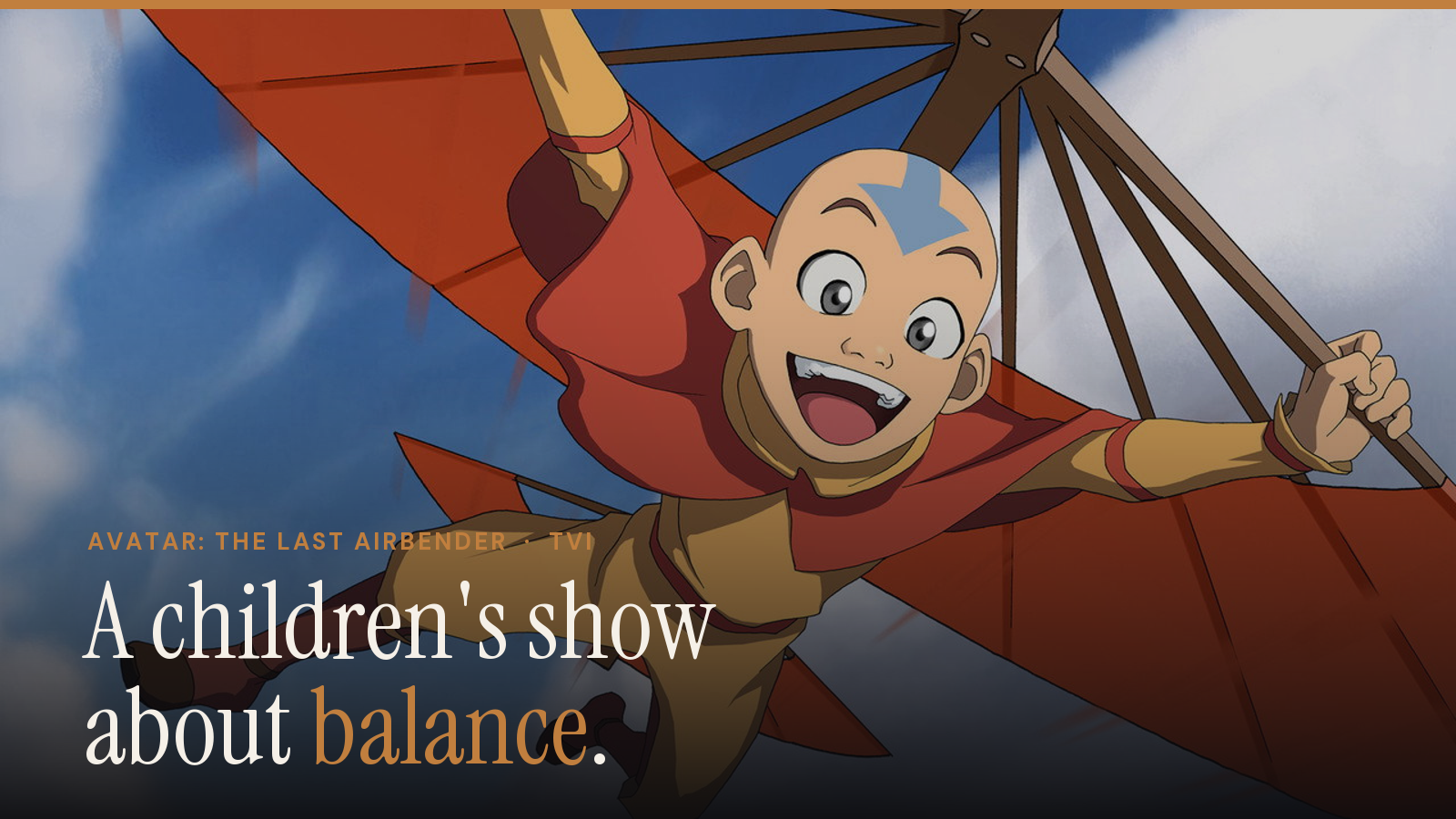

A child remembers the images first.
A boy glowing inside an iceberg. A flying bison crossing the sky. A blind girl who sees through the soles of her feet. A prince with a scar where a father's love should have been. An old man singing to a son who will never answer.
The images go in before the vocabulary does. Then the viewer grows up, returns, and realizes the adventure had been teaching them how to grow up the entire time.
Some shows are remembered because children loved them. A smaller number are remembered because they helped a child organize the world, and the child only discovers the difference years later, when the show reopens and explains something they had finally lived long enough to understand.
Avatar: The Last Airbender is the second kind.
Here is the claim. Avatar gives children a fantasy of elemental power, then spends sixty-one episodes teaching that power is not maturity. Power becomes safe only when it is integrated, restrained, and turned toward repair.
That is the deeper lesson, the one the adventure never stops to announce. The show teaches it through motion, jokes, battles, mistakes, grief, and friendship. It does not flatten itself into a moral. It gives a child the world in symbolic form and trusts the child to keep growing into it.
A children's show does not earn lasting status because adults are nostalgic for it. It earns that status when the thing children loved turns out to have been helping them become people. That is what Avatar does, and it is why it lasts.
I have watched Avatar: The Last Airbender as a viewer, as a school psychologist, and now as a parent-facing reviewer thinking about what children carry from a story over time.
What earns it the TVI Kids Essential designation is not that it exposes children to hard subjects. It is that it gives those subjects form. Grief has form. Shame has form. Anger has form. Power has form. Friendship has form. A child watching may not be able to explain all of that yet, but they can feel the difference between power used to dominate and power placed in service of repair.
The show's developmental value is unusually complete. It supports self-awareness, self-management, social awareness, relationship skills, and responsible decision-making across multiple character arcs, not just one protagonist. That is why it earns a 49 of 50 on the SEL scale.
One note from the clinical side, separate from the content warning above. The hard scenes land differently when a child meets them alone, so watch the heavy stretches together when you can. You do not have to narrate them or soften them. Your presence in the room does most of the work. If a scene stays with your child, let them be the one to bring it back, and answer the question they actually ask rather than the one you are bracing for.
I review the shows and the methodology, not your individual child. These are picks, not prescriptions.
Cordelia Witty, EdS., NCSP
Why it matters developmentally
Most children's shows teach virtue by naming it. A character learns honesty or courage or kindness, the music confirms the lesson, and the episode closes before anything gets complicated.
Avatar almost never teaches that way. It builds situations a character cannot survive unchanged. Then it lets the growth cost something. That cost is the source of the show's authority.
Across the ensemble, Avatar stages self-awareness, emotional regulation, empathy, grief, shame, accountability, moral refusal, and the responsible use of power with unusual completeness for children's television. These are not after-school morals pasted onto adventure. They are built into the character architecture.
Aang carries joy under responsibility. Katara carries grief that wants to become revenge. Zuko carries shame. Sokka carries the dignity of competence without supernatural endowment. Toph carries the difference between autonomy and isolation. Iroh carries love after loss.
Put them together and you get something close to a map of growing up. It is the same logic the show brings to the elements: the Avatar has to hold all four without letting any one take over, and the cast holds the pieces of one growing person between them, each carrying what the others cannot.
That matters because childhood is not simple. Adults often remember childhood as innocence, but children know better. They know fear. They know shame. They know the panic of exclusion, the violence of unfairness, the grief of losing something they cannot restore. What they do not yet have is structure. They do not know where to put the feeling.
Avatar gives the feeling a place to live. The show does not rescue children from complexity. It gives complexity form. A child may not be able to say, I am watching shame reorganize into self-authorship, but they can watch Zuko stop living inside his father's sentence. They may not be able to say, I am watching grief refuse the revenge identity, but they can watch Katara walk away in the rain. The story does the teaching before the vocabulary arrives.
No show raises a child. A series is not a parent, a school, or a curriculum. What Avatar offers is rehearsal. It lets a child feel a difficult human pattern safely before life asks them to meet it without animation, music, or a flying bison. That is not a small thing to give a child.
Balance is not stillness

The fantasy system works because it is not arbitrary.
Water adapts. Earth stands. Fire wills. Air releases.
Each element is a power, but each is also a way of meeting the world. Water can become compassion or avoidance. Earth can become steadiness or rigidity. Fire can become vitality or domination. Air can become freedom or disappearance.
The show teaches this first through motion. Katara's water does not move like Toph's earth. Toph's earth does not move like Zuko's fire. Zuko's fire does not move like Aang's air. The metaphysics enters the child as style before it becomes thought.
That is why the Avatar's task is not to collect four powers. The task is integration. When to flow. When to stand. When to act. When to let go. How to hold all four without letting any one become the whole self.
This is also why the word balance is easy to misunderstand. Balance in Avatar does not mean nothing moves, or every force canceling every other into a dead center. Balance is living coherence under motion.
A body is balanced while walking because it is constantly making tiny corrections. A culture is balanced not because nothing changes, but because its parts can absorb change without losing form. A person is balanced not because they have no anger, no grief, no fear, no desire, but because those forces can move through them without taking over the whole life.
The show understands this. Its balance is closer to a helix than a statue. The Avatar cycle returns through air, water, earth, and fire, but each return happens in a different historical moment, through a different body, under different demands. The pattern persists by changing.
That is why the world of Avatar feels alive. It is not trying to freeze balance. It is trying to keep a pattern coherent while history keeps bending it. The elements are not decoration. They are the show's grammar for becoming whole.
Power becomes safe only when it is integrated, restrained, and turned toward repair.
The swing back and the spiral upward

Every element in the show has a distortion, and every distortion eventually calls forth its opposite.
Too much air becomes escape. Too much earth becomes rigidity. Too much fire becomes domination. Too much water becomes avoidance. Each excess creates the need for correction. That is what systems do. Push too far in one direction and reality starts pulling back.
But Avatar is smarter than a simple pendulum. It is not interested in swinging from one extreme to the other forever. The show keeps asking for the higher return.
Aang does not solve fear by becoming aggressive. He learns to stand without losing air. Zuko does not solve shame by becoming proud in the same wounded way. He becomes self-authored. Katara does not solve grief by becoming detached. She stays loving and refuses revenge. Toph does not solve dependence by submitting. She lets people in without surrendering strength.
That is not back and forth. That is a spiral.
The first movement is innocence. Then comes injury, excess, distortion, compensation. Then, if the character can bear the work, something returns at a higher level: the old part comes back with more consciousness inside it.
This is why the finale matters. Aang's refusal to kill Ozai is not a regression into childish purity. It is a return to his deepest value after the world has forced him to understand violence. He does not end where he began. He comes back higher. That is what integration means.
The chakra episode is the key

If there is one episode that tells you what the whole series has been doing, it is Book Two, Episode 19, "The Guru."
Guru Pathik walks Aang through seven blocked centers of energy, each tied to an emotional obstruction: fear, guilt, shame, grief, lies, illusion, and attachment. The language is mystical. The function is developmental. The episode hands children an idea most television never bothers to offer: the inner life has structure. Fear blocks one thing. Guilt blocks another. Shame blocks another. Growth is not a vague glow of improvement. It is specific obstructions faced honestly.
Aang's obstructions are not abstractions. They are the plot. He fears the responsibility of a world that collapsed while he was gone. He carries guilt for the century he was absent. He feels shame for what the Avatar State did through him. He grieves Monk Gyatso and the Air Nomads. He cannot release Katara.
Then the episode becomes more interesting than its own lesson. Pathik tells Aang that to fully access the Avatar State, he must let go of earthly attachment. Aang refuses. He chooses love, and the lesson fails.
A lesser show would return later and correct the child: renounce attachment, become powerful, save the world. Avatar does something braver. It lets Aang become whole without abandoning love. The task is not to stop loving. The task is to love without possession, to carry attachment without being ruled by it.
That is a startlingly mature claim to hand a child, and I want to be careful not to overstate how cleanly the show argues it. The series does not resolve the tension between love and power in a single scene, and it should not. What it does is refuse the easy answer, and then keep living inside the harder one. The chakra episode is the key not because it solves the show, but because it names out loud the structure the rest of the series has been dramatizing: the battles are never only external. Power without inner integration just reproduces the violence it defeats.
Aang: joy under responsibility
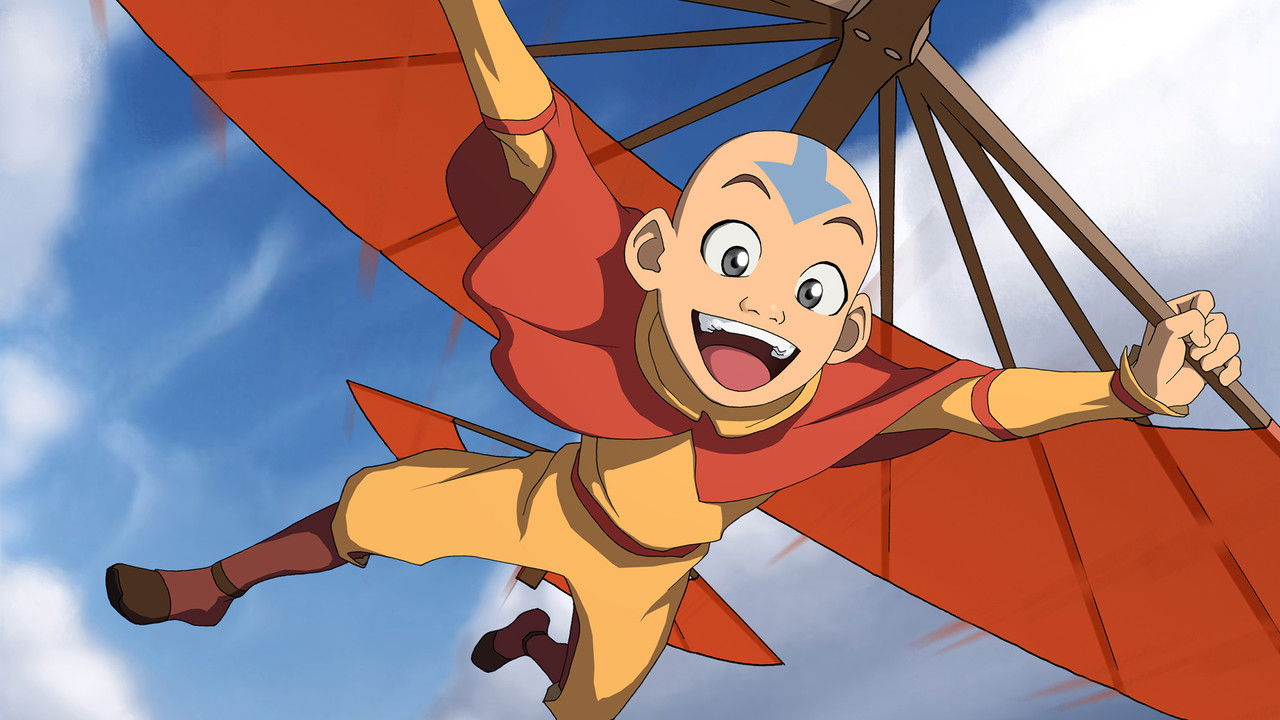
Aang is twelve, and the show never lets responsibility erase that fact.
He sleds on penguins. He wants games, snacks, jokes, motion, wonder. He is also the last survivor of a murdered people and the one person expected to end a century of war. The world asks him to grow up fast. The show refuses to confuse growing up with becoming joyless.
That refusal is not softness. It is the center of the character. Aang's work is not to kill the child in himself so the savior can operate without interference. His work is to keep the child alive inside the person the world is demanding he become.
That matters because the Air Nomads were not only a culture of detachment and spiritual discipline. They were also a culture of movement, play, lightness, and delight. If Aang loses joy entirely, the Fire Nation has taken more than his people. It has taken the way his people knew how to be alive.
That is why his refusal to kill Ozai is not a side issue in the finale. The world offers him the mature-sounding answer: violence is necessary, mercy is naive, adulthood means accepting the dirty work. Aang looks for another way, not because he is childish, but because saving the world by betraying the moral center of his vanished people would be a damaged victory.
Energybending is mechanically convenient. Thematically, it is exact. Aang wins by finding a form of power that does not require him to become the mirror of the force he is defeating.
That is the spiral: not innocence preserved by ignorance, but innocence recovered after knowledge. He comes back to mercy, but not as the boy who ran from responsibility. He comes back as the Avatar who has seen what violence is and still refuses to let it author him.
Zuko: shame and self-authorship
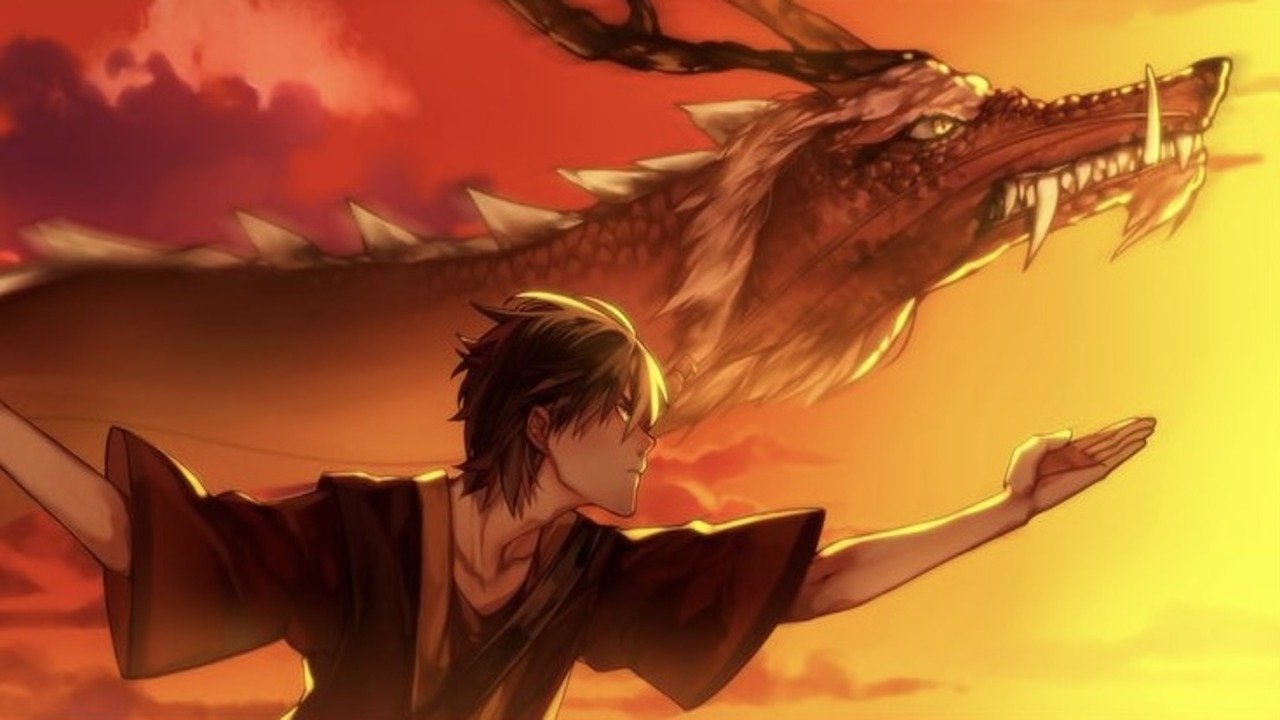
People call Zuko's arc redemption. That is true, but it is not deep enough.
Zuko's real story is recovery from shame.
He is a child burned by his own father, exiled, and told he can earn his way home through an impossible task: capture the Avatar, restore your honor, become acceptable again. The mission was never about honor. It was about a boy trying to become lovable to the person who injured him.
The show understands the cruelty of that arrangement. Abusive systems often replace love with a condition, then call the child's desperation loyalty. Zuko spends most of the series trying to satisfy a verdict that should never have had authority over him.
The arc works because the show lets him fail after growth has already begun. He nearly changes in the caves under Ba Sing Se. Then he chooses Azula. He gets the restoration he thought he wanted: status, proximity to his father, the official return of honor. And then he discovers the reward is hollow. Iroh could tell him that a hundred times. He has to inhabit the hollowness before he can know it.
So when Zuko confronts Ozai during the eclipse, the moment does not feel like a switch flipping. It feels like authorship returning. He narrates his life from the inside for the first time. Recovery from shame is not pride. Pride can remain organized around the wound. Recovery is taking back the right to say who you are, instead of living out a sentence the person who hurt you handed down.
The scar remains. That matters. Healing does not erase the mark. It changes who gets to interpret it.
Zuko's fire comes back differently. At first it is rage arranged around injury. Later, after the Sun Warriors and the dragons, fire becomes life. Warmth. Breath. Continuity. The element returns, but higher. He does not stop being fire. He stops being possessed by the wounded version of it.
That is why the arc endures. It is not that the villain becomes good. It is that a child stops mistaking his wound for his identity.
Katara: grief, anger, and mercy
Katara is often remembered as the responsible one. She is also one of the angriest people in the show, and the series is wise enough not to scold the anger out of her.
Her mother's death runs under everything she does. It shapes how she loves, protects, fights, mothers the group, and threatens the people who endanger it. Her care and her rage come from the same wound.
In "The Southern Raiders," she finds the man who killed her mother. The show gives her the kill. The rain is falling. The water rises. Revenge is present, available, almost physically in her hands.
Then she walks away.
The scene is mature because it refuses cheap forgiveness. Katara does not absolve him. She does not discover that he deserves peace. She does not become gentle toward him. She sees that the man in front of her is too small to hold the meaning of what he took. Killing him would not restore her mother. It would bind her future to him permanently.
So she refuses the future the wound was building.
That is the lesson. Not forgiveness as warmth. Not mercy as denial. Mercy as the refusal to become the shape of the injury. Sometimes healing is not forgiving the person who hurt you. Sometimes it is declining to let them keep authoring your life.
Water moves. That is the point. Katara does not become untouched by grief. She becomes capable of letting grief move without letting it decide the entire direction of her life. The wound does not vanish. The river keeps going.
Sokka: competence without magic
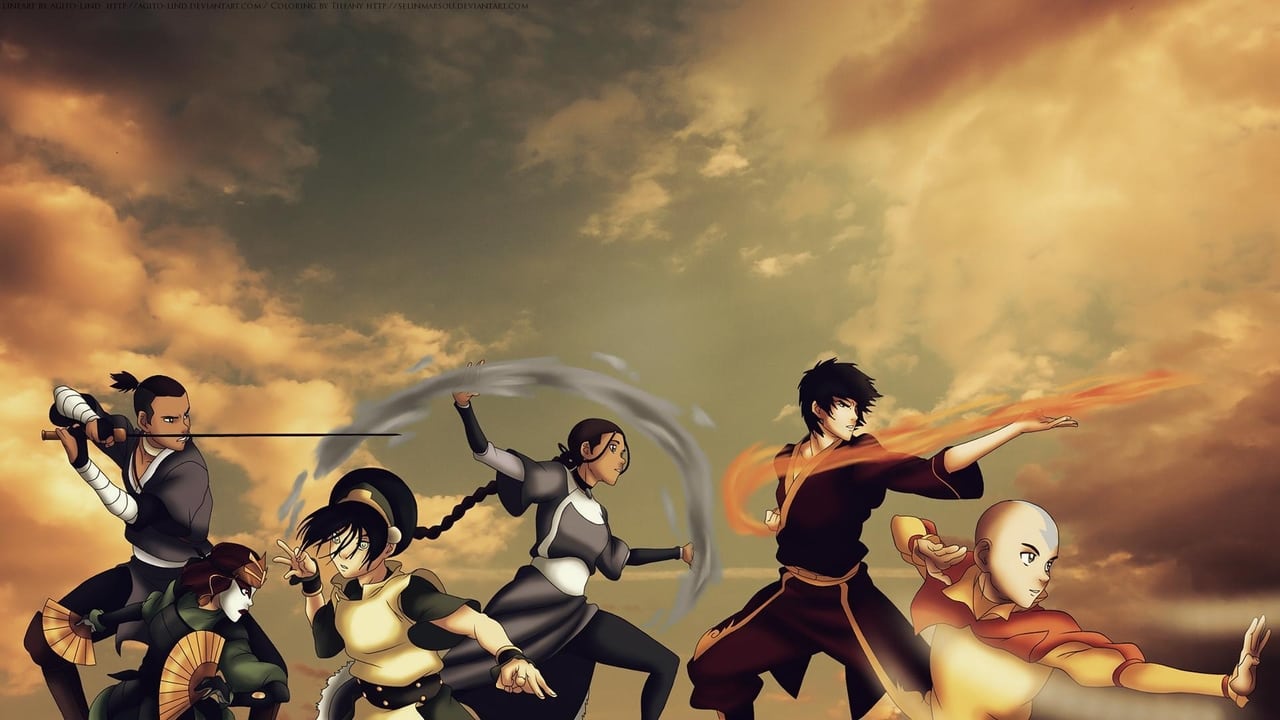
Sokka cannot bend. In a world built around bending, that should make him auxiliary. The show refuses.
Everyone around him has a supernatural gift. Aang masters all four elements. Katara becomes a master waterbender. Toph is one of the strongest earthbenders alive. Zuko is firebending royalty. Sokka has no hidden element waiting inside him. He has to build what he becomes.
That is why his arc matters so much. He learns strategy. He invents. He plans the invasion. He studies swordsmanship under Piandao because mastery did not arrive through bloodline. In the final battle, he helps bring down the airship fleet with attention, nerve, craft, and no magic at all.
The benders give children fantasy. Sokka gives them method.
Most children are not chosen. Most will not discover that history has placed a secret gift inside them. Sokka is not the consolation prize for those children. He is the usable model. Intelligence, loyalty, humor, craft, planning, and disciplined effort are not lesser powers. They are the human powers, and they are the ones a child can practice tomorrow.
Sokka also protects the show from its own mythology. Without him, the elemental system could imply that worth is inherited. Sokka keeps the opposite truth in the room. Power is not only what you are born able to bend. Power is attention trained into competence. Power is humor that keeps despair from freezing the group. Power is the plan nobody else thought to make. In a world of chosen ones, he is the dignity of the unchosen person who still chooses to become useful.
Toph: autonomy without isolation
Toph arrives as pure force.
Blind, brilliant, funny, blunt, and nearly impossible to move, she is the greatest earthbender in the world because she listens to the ground more honestly than anyone else. The world underestimates her. Her family smothers her. Her answer is a wall: I do not need anyone.
The wall makes sense. That is why the arc works.
Toph does not need to become strong. She already is. Her task is harder: learning that dependence is not humiliation, that being known is not the same thing as being controlled, and that letting people matter does not return her to the cage she escaped.
The show never asks her to become smaller so she can be loved. That is crucial. She remains fierce. She remains difficult. She remains Toph. What changes is not her strength, but her willingness to let people in without trading it away.
That is earth at its best. Not a wall, but ground. A wall separates; ground supports. Toph's development is the movement from one version of earth to the other. For a child who has been underestimated, overprotected, or praised only for competence, that is a rare and generous model.
Iroh: the adult who stays
Iroh is remembered as comfort: tea, jokes, patience, wisdom with a smile.
The memory is right and incomplete. His warmth has weight because it comes after ambition, war, failure, and the death of his son. He is not gentle because nothing happened to him. He is gentle because something did, and he chose not to let it make him cruel.
That is why he can help Zuko. He does not excuse the harm Zuko does. He does not deny the wound. He does not force insight before Zuko can metabolize it. He stays close enough for the boy to imagine another way of being, and patient enough for that way to become Zuko's own.
"The Tales of Ba Sing Se" reveals the ground beneath the patience. Iroh sets out a small picnic for Lu Ten, his dead son, on his birthday. He sings, and he breaks. The scene does not solve grief. It honors continuation. Love does not end because the body is gone. It changes form and keeps asking for expression.
For a child, this is a model of mourning. For an adult watching beside them, it may be the moment the show stops being safe in the way cartoons are supposed to be safe and becomes safe in a deeper way: safe enough to tell the truth.
Iroh is the adult the show believes in. Not the adult who has never failed. Not the adult who has mastered life into certainty. The adult who has been broken open and decided to become shelter anyway. That may be the rarest thing in the series.
The Air Nomad genocide is treated as real loss
In the third episode, the show tells the child viewer that Aang's people are gone.
Not missing. Not waiting to be found. Gone.
The Southern Air Temple is still standing. The architecture is intact. The air still moves through the rooms. Then Aang finds Monk Gyatso's remains, and the boy who survives by motion stops.
This is one of the most honest depictions of cultural loss in mainstream children's media. The show does not use genocide merely to motivate revenge. It makes it a carrying problem. How does a child remain faithful to a destroyed culture while saving the world that destroyed it. How does joy survive as inheritance. How does a tradition continue when its last child is also being asked to become the world's instrument of repair.
The finale does not fix this. It cannot. Some losses are not solved by narrative closure. They are carried. Avatar trusts children to feel that before they can fully explain it, and that trust is part of its greatness.
What to watch for
These episodes are especially useful for parents and adult co-viewers:
Book One, Episode 3, "The Southern Air Temple": genocide, cultural loss, and Aang's first overwhelming grief.
Book Two, Episode 7, "Zuko Alone": exile, shame, family violence, and the wound beneath Zuko's anger.
Book Two, Episode 15, "The Tales of Ba Sing Se": grief, continuing love, and Iroh's emotional center.
Book Two, Episode 19, "The Guru": the developmental map of fear, guilt, shame, grief, lies, illusion, and attachment.
Book Two, Episode 20, "The Crossroads of Destiny": Zuko's failed almost-redemption, which makes the later one believable.
Book Three, Episode 13, "The Firebending Masters": fire recovered as life rather than destruction.
Book Three, Episode 16, "The Southern Raiders": revenge, mercy, and grief without sentimentality.
Book Three, Episodes 18 to 21, "Sozin's Comet": integration, restraint, and the final moral test.
Use these as anchors, not homework. The show is best watched as a story first.
Verdict
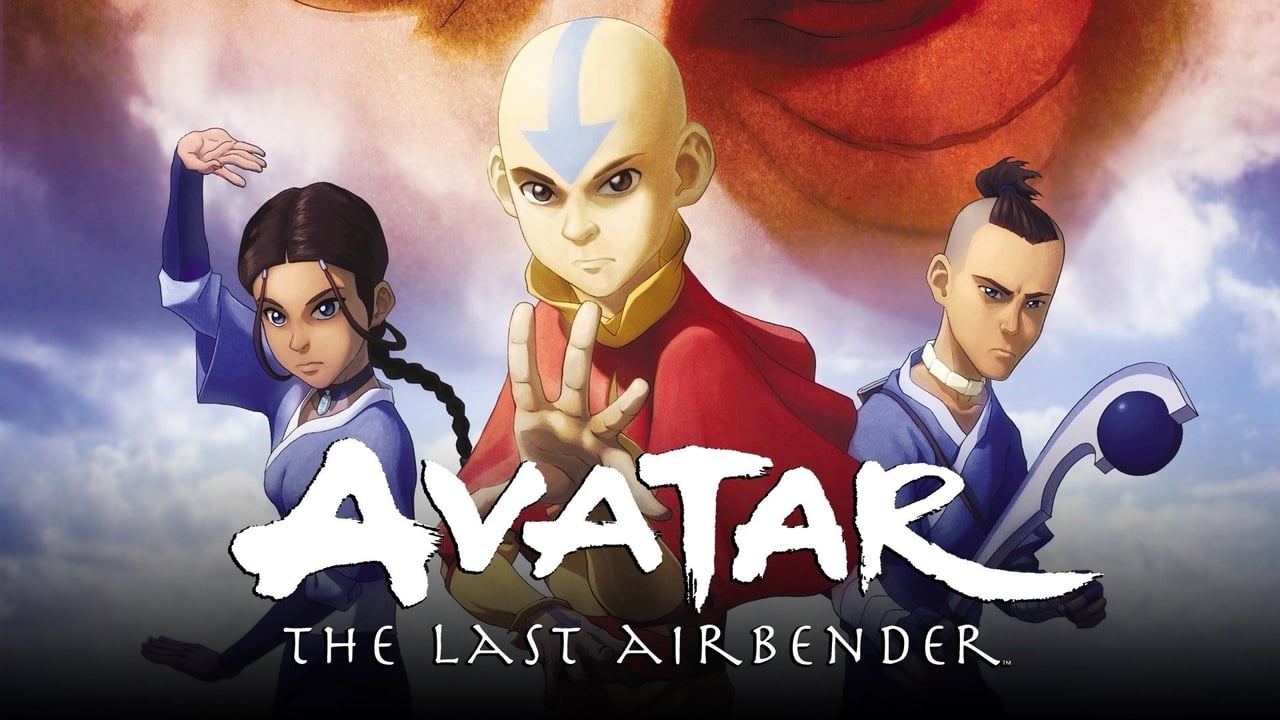
Avatar: The Last Airbender is essential because it gives children a full moral architecture and hides it inside adventure until they are ready to find it.
But the deepest thing the show teaches is not any single character's lesson. It is the structure underneath them all. You do not become whole by picking one element and perfecting it into dominance. You do not become whole by swinging from one extreme to its opposite and calling the recoil balance. You become whole by returning higher, letting the old part come back with more consciousness inside it. Joy after responsibility. Fire after shame. Connection after isolation. Love after grief. Mercy after the knowledge of violence.
And none of it is done alone. Avatar is, in the end, a story about a found family that chooses each other again and again, and the becoming-whole it teaches is something they do together.
The child gets motion, jokes, battles, animals, and wonder. The adult sees the architecture. Both are watching the same show.
And one day, years later, when the world hands that child fear, shame, grief, power, anger, loneliness, or the temptation to mistake domination for strength, some part of them may already have been there once. In the rain. In exile. Beside a picnic set for someone gone. On the back of a flying bison.
They may not remember the lesson as a sentence.
They will remember the way back to each other.
TVI Kids Essential #2. Watch it with them. Then watch it again when they are older.
Conversation, not homework
The show rewards conversation. These are not comprehension questions. They are conversation starters. Pick one or two. Do not turn the show into homework.
For viewers of any age (alone, with a partner, or with a child)
- The Guru tells Aang he must release attachment to the people he loves. Aang refuses. What does the show seem to be saying about the relationship between love and growth?
- Zuko spends most of the show carrying shame he did not earn. What helps him stop carrying it? Who, in your own life, does for you what Iroh did for him?
- Sokka has no bending. He invents. He plans. He learns the sword. What does the show seem to be saying about what people can do without supernatural endowment?
For parents watching with children, especially ages 8 to 12
- Aang is the last of his people. What do you think it would feel like to be the last of a group you loved? What does Aang do that helps him keep going?
- The four nations all have their own way of fighting and their own way of seeing the world. What makes each one different? Is one better than the others, or does each one know things the others do not?
- Iroh has a son who died. He never stops loving his son. What does Iroh do, on his son's birthday, that shows he is still loving someone who is gone?
The show operates at multiple registers. Children pick up far more than they can articulate. The prompts exist to give them a chance to show you what they noticed.
TVI Score Breakdown
| Dimension | Score | Weight |
|---|---|---|
| Cognitive Stimulation | 46 / 50 | 0.40 |
| Educational Value | 44 / 50 | 0.35 |
| Craft & Quality | 46 / 50 | 0.25 |
| Composite (TVI Score) | 181 / 200 | Masterclass tier |
| SEL Score (CASEL framework) | 49 / 50 | n/a |
Formula: round((46 × 0.40 + 44 × 0.35 + 46 × 0.25) × 4) = round(181.2) = 181
Methodology note: TVI's composite score combines three weighted dimensions across a 0-to-200 scale. The SEL Score (Social-Emotional Learning) is scored separately on the CASEL framework's five competencies (self-awareness, self-management, social awareness, relationship skills, responsible decision-making), built and overseen by Cordelia Witty, EdS., NCSP. Score locked at publication, reflects TVI methodology v1.2. Full methodology at tvintelligentsia.com/methodology.
Disclaimer: TVI's score is a content rating, not a measurement of a child's intelligence or a viewer's intelligence.
Two free guides built on the same lens, and the work behind the number.
Free guideThe Substance ListTwenty-four films and shows, grouped by what they actually do to you. Free guideKinds of MindHow fiction imagines intelligence, read across twenty-one characters. EditorialThe Lion King, reviewedAn inherited pattern, and how grief becomes a throne. MethodologyHow the TVI Score worksThree weighted dimensions. One published rubric. Every score citable.About the authors
About TV Intelligentsia. TV Intelligentsia is an independent credibility layer for what to watch. We score films and television on a public methodology grounded in cognitive science, developmental psychology, and media-effects research. TVI Kids Essential is our highest designation for children's content; Avatar: The Last Airbender is Essential #2, the second ratification under the TVI Kids Essential framework (v1.1), following The Lion King (1994). We do not accept studio money. Find us at tvintelligentsia.com.
Series: Avatar: The Last Airbender (2005-2008), created by Michael Dante DiMartino and Bryan Konietzko. Head writer Aaron Ehasz. Music by Jeremy Zuckerman and Benjamin Wynn (The Track Team). Iroh voiced by Mako Iwamatsu in Books One and Two, Greg Baldwin in Book Three. Distributed by Nickelodeon. Sixty-one episodes across three books. Reviewed against TVI methodology v1.2 by Jordan Robinson, MD, MPH (Founder, TV Intelligentsia) and Cordelia Witty, EdS., NCSP (Co-founder, TVI Kids). Score 181/200 (Masterclass). TVI Kids Essential #2. Companion editorials at /reviews/avatar-elements-decoded/ (mystic decoding) and /kids/avatar-last-airbender-developmental/ (Cordelia developmental piece). Published May 26, 2026 at tvintelligentsia.com/reviews/avatar-last-airbender.